

Category: News
-

Myths and Facts on Cholesterol!
Read More: Myths and Facts on Cholesterol!I’m a huge fan of patients being at the centre of their own care, and the more you learn about your condition and how it’s treated, the more you can make good decisions in conjunction with your clinical team! But there’s a lot of really unreliable information on the internet, so just be careful about…
-

How Do PCSK9 Lipid Lowering Therapies Work for FH
Read More: How Do PCSK9 Lipid Lowering Therapies Work for FHExpanded PBS access to PCSK9 inhibitors may offer new options for people with FH. For people living with familial hypercholesterolaemia (FH), lowering LDL-cholesterol (“bad cholesterol”) is essential to reduce the risk of heart attack and stroke. While diet and lifestyle changes are important, most people with FH need medication to reach safe cholesterol levels. In…
-
Understanding the Lipid Panel
Read More: Understanding the Lipid PanelA lipid panel, or lipid profile, is a blood test that measures the amount of fat molecules called lipids in your blood. These substances are important for your body to function, but when they are at unhealthy levels, they can increase your risk of heart disease and stroke by causing plaque to build up in…
-
Inherited Cholesterol and Heart Scans
Read More: Inherited Cholesterol and Heart ScansInherited conditions such as familial hypercholesterolaemia (FH) or high lipoprotein(a) [Lp(a)] can increase the risk of coronary heart disease. These conditions may lead to early plaque build-up in the coronary arteries, even in people who feel well. In some cases, non-invasive scans can help to provide a personalised picture of risk and guide treatment decisions.…
-

Brian’s Story
Read More: Brian’s StoryLp(a) awareness saves lives. I first discovered I had high cholesterol at the age of 17. It came about by chance, after routine blood tests for an unrelated issue revealed unusually high levels for someone my age. My doctor kept a close eye on me over the years and, while my cholesterol remained on the…
-

Genetics 101 for FH
Read More: Genetics 101 for FHGenetic testing for familial hypercholesterolemia (FH) starts by sequencing specific genes in the person first diagnosed (called the proband or index case). The key genes tested are LDLR, APOB, and PCSK9. Instead of using the word “mutation,” we now use “variant” to describe any change in a gene. Since we inherit two copies of each gene (one from each parent),…
-
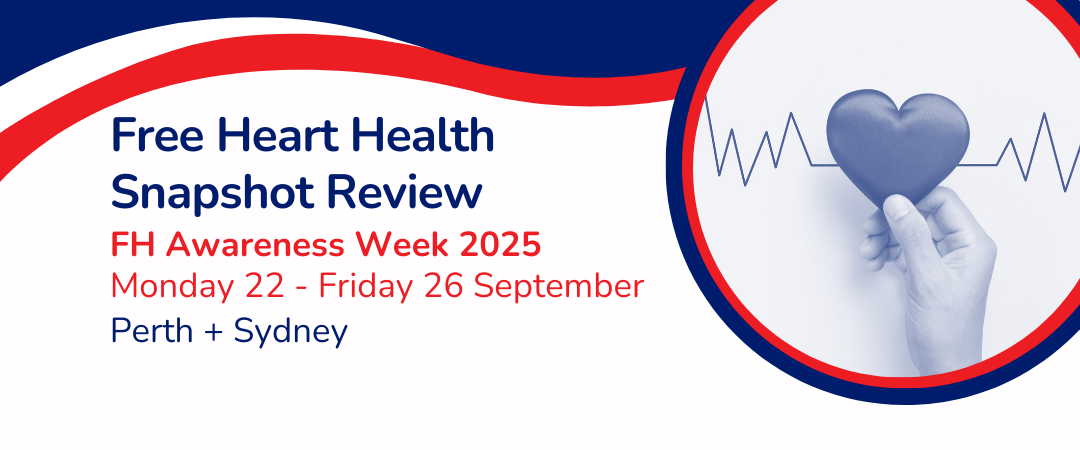
Free Heart Health Snapshot Review
Read More: Free Heart Health Snapshot ReviewVisit our pop-up stalls in Perth and Sydney this FH Awareness Week for a free heart health snapshot, quick cholesterol test and have your cholesterol questions, including family history of high cholesterol answered. Perth Tuesday 23 – 9am – 12pmFiona Stanley Hospital Wednesday 24 – 9am-12pm St John of God Midland Thursday 25 – 8am –…
-

A focus on homozygous familial hypercholesterolaemia (HoFH)
Read More: A focus on homozygous familial hypercholesterolaemia (HoFH)Homozygous familial hypercholesterolaemia (HoFH) is the most severe form of FH and usually presents in childhood. It is rare, affecting about 1:300,000 people and occurs when a person inherits 2 faulty copies of the LDL receptor gene (or sometimes other genes which cause FH), one from each parent. As a result, the LDL cholesterol (LDL-C)…
-

Lipoprotein(a) – What’s all the noise about?
Read More: Lipoprotein(a) – What’s all the noise about?Lipoprotein(a) [Lp(a)] – pronounced “lipo-protein little a”, or “LP little a” is the most common inherited risk factor for heart disease. High Lp(a) levels occur in 20% of people, yet only 1-2% have ever been tested. It is structurally very similar to low-density lipoprotein (LDL) cholesterol, which makes Lp(a) uniquely ‘sticky’. This ‘stickiness’ encourages the…
-

Novel Therapies: Research to fight high cholesterol with genetic patches
Read More: Novel Therapies: Research to fight high cholesterol with genetic patchesFamilial Hypercholesterolemia (FH) is a genetic condition that causes high cholesterol levels. In about 90% of cases, this happens because of changes in a gene called LDLR, which affects how the body clears “bad” cholesterol (LDL) from the blood. Normally, the LDLR protein acts like a tiny catcher, grabbing LDL and pulling it into liver cells,…